
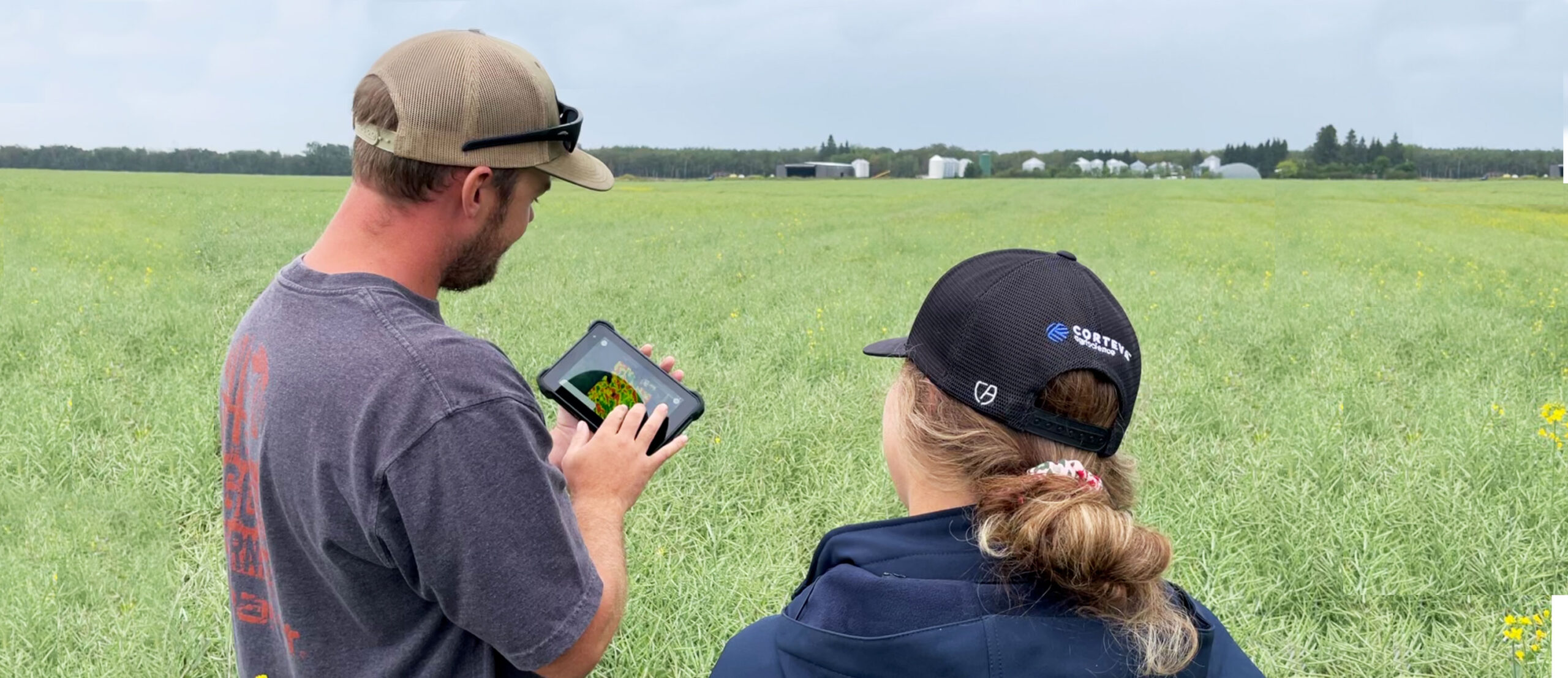
Precision agriculture promises to reduce costs and increase yields—but what does the data actually show?
Over the past two decades, researchers, equipment manufacturers, and farmers have all attempted to quantify the return on investment (ROI) of precision agriculture. While results vary, a consistent picture is emerging: the benefits are real, but typically incremental rather than transformative. Understanding where that ROI comes from—and how it’s achieved—is key to making informed decisions about adopting precision technologies.
Measured gains: what the research shows
Across multiple peer-reviewed studies and meta-analyses*, precision agriculture technologies consistently deliver input cost reductions of 8–20%, yield increases of 2–6%, and overall ROI in the range of 5–15%.
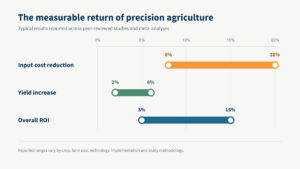
These findings come from large-scale reviews of global research, including recent analyses published in agricultural economics and agronomy journals. Rather than dramatic one-time gains, precision agriculture tends to produce steady improvements in efficiency over time—reducing waste while optimizing production.
Why ROI varies from farm to farm
One of the most important, and sometimes overlooked, insights from the data is that ROI is not uniform. Precision agriculture delivers the strongest results in fields with high variability, including:
- Soil differences
- Drainage issues
- Inconsistent historical yields
In these environments, even small adjustments to inputs or management practices can have outsized impacts. By contrast, highly uniform fields tend to show smaller gains, simply because there is less inefficiency to correct.
Farm size also plays a role. Larger operations often achieve higher returns because they can spread the cost of technology across more acres.
Input savings: a major driver of ROI
A significant portion of precision agriculture’s economic value comes from using fewer inputs more effectively. Technologies like variable rate application (VRA) and section control allow farmers to:
- Apply fertilizer only where needed
- Avoid over-seeding low-performing zones
- Reduce fuel consumption
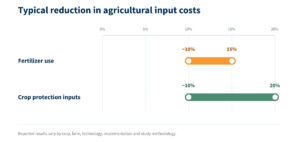
Research suggests that farmers can reduce fertilizer use by ~10–15%, and crop protection inputs by ~10–20% by adopting precision agriculture tools and methods.
Parry Casson and his family operate a ~2,000-acre grain farm in Medstead, Saskatchewan. Mostly soybeans, canola, barley, and wheat.
“Every year we spend about $400,000 on fertilizer, $150,000 on herbicides, $30,000 on fungicides, $100,000 on seeds, and $40,000 on fuel.” (All numbers in CAD).
With input costs rising above $700,000/year it’s no wonder the Cassons, like most farmers, are looking for ways to do more with less. Any technology that can improve your yield while reducing your input requirements by 10% would pay for itself very quickly.
”“Any new precision agriculture technology capable of reducing fertilizer, fungicide, and seed costs by 10%, would pay for itself very quickly.“
Yield gains: small percentages, big impact
Yield increases from precision agriculture are typically modest in percentage terms, but meaningful in financial terms. A 2–5% increase in yield may not sound significant, but across hundreds or thousands of acres, it can translate into substantial additional revenue. Importantly, these gains are rarely driven by a single technology. Instead, they result from a combination of improvements:
- Better input placement
- More accurate timing of operations
- Improved crop and hybrid selection
- Continuous refinement of field strategies
Over time, these incremental improvements compound.
Where FarmTRX fits
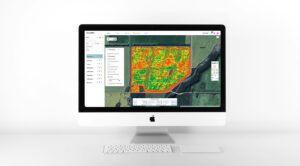
FarmTRX plays a specific and important role within this broader precision agriculture system. Our products generate the accurate, high-resolution yield maps farmers and agronomists rely on to make informed decisions about:
- Variable rate seeding strategies
- Fertilizer optimization plans
- Crop and hybrid selection
- Irrigation and drainage decisions
- Targeted pest and disease management
FarmTRX is at its core a foundational technology—one that supports and amplifies the value of other precision agriculture tools. Yield maps have been integral to precision agriculture for years– and they help farmers become more effective. According to a 2021 study done by the University of Northern Iowa, yield maps increase expected efficiency by 8.5%.
Precision Agriculture Is a system, not a single tool
One of the most consistent conclusions in the research is that precision agriculture works best as a system of interconnected practices, not a standalone solution.
Technologies such as:
- Variable rate seeding
- Fertilizer optimization
- Irrigation management
- Pest and disease control
all rely on accurate, field-level data to be effective. Without field-level data, farmers and agronomists must rely on field averages or assumptions when making decisions about next year.
With many family farms experiencing increasing financial pressure this year (family farm bankruptcies increased by 46% in 2025!), some are adopting precision agriculture methods to minimize costs and maximize yield for coming seasons.
ROI examples from the Casson farm
A few years back, the Casson farm had some trouble with fusarium head blight and leaf rust in their wheat fields. They decided to try a new fungicide during the month of July; it was expensive, but well worth a try as the stakes were high.
The Cassons measured early results using NDVI (Normalized Difference Vegetation Index) imagery. This remote sensing technology uses satellite imagery to measure plant health and greenness by analyzing how surfaces reflect visible and near-infrared light.
The early results looked spectacular.
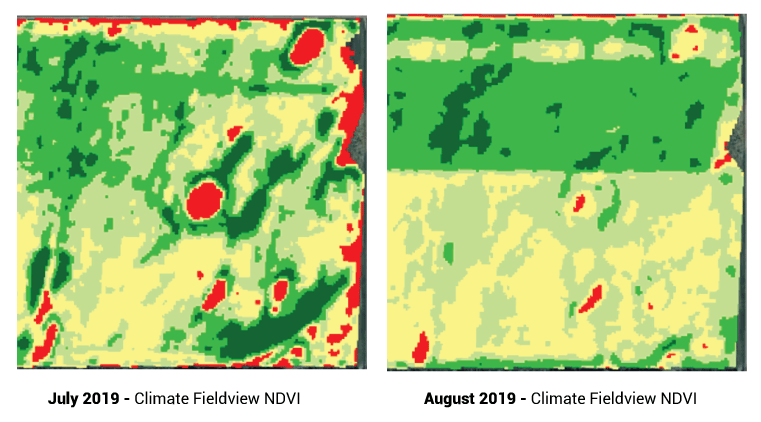
“You could see exactly where I unfolded the booms and started spraying.” says Bryn Casson. “It seemed to be working perfectly. We were all expecting to see improved yield results based on the early satellite imagery.”
The early trials suggested it would be prudent to use the fungicide on the whole field, despite the high costs. In the end they decided to wait for the final verdict. With hindsight, this was a good call. This specific fungicide produced strong plant health and growth, but for this trial and crop, it had very little impact on the yield itself.
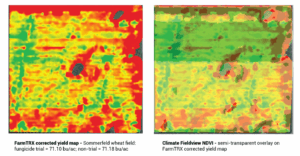
“Satellite imagery like NDVI can be a great tool, but it doesn’t necessarily translate to your final yield. You need a yield monitor to get reliable data from your fields”, concluded Casson.
The Casson farm also deals with significant year-to-year moisture variability. In 2020, areas of an 180-acre field received 8 inches of rain in three days, drowning out the canola crops in low-lying areas.
The following year, 2021, was very dry with only 4 inches of rain the entire growing season. Perhaps not surprisingly, the previously flooded areas saw the biggest yields that year.
The wet 2020 and the dry 2021 seasons resulted in nearly inverse yield maps, and this contrast provided crucial information.
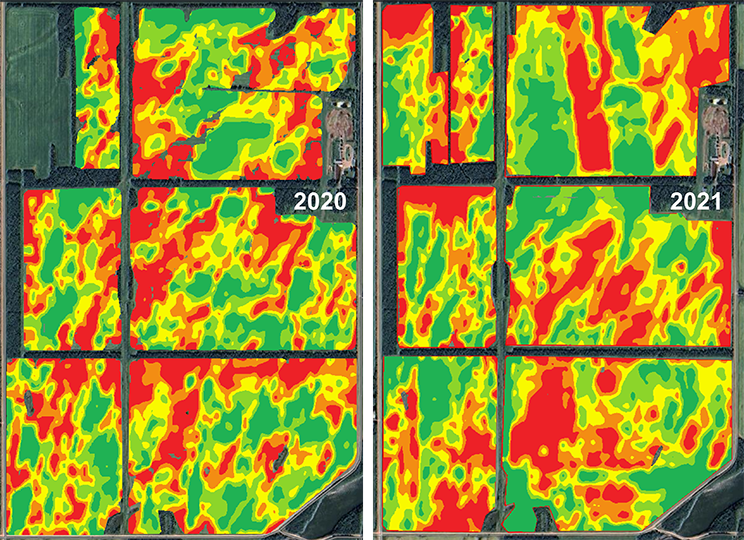
“We knew we were losing money to these low-lying spots every wet year,” says Bryn Casson. The question was how much? A couple hundred bucks or $100,000?”
Until they had yield maps to measure the yearly variations, they didn’t know how bad specific areas were.
“We needed to know if we should invest our money in variable rate or a drainage program. Should that be tile or trenching?”
After reviewing the yield maps, they estimated that the 2020 flood alone led to about $50,000 in yield loss.
“We were able to pinpoint precisely where and how much each field’s drainage affected profitability. Projecting this cost/benefit analysis over time helped us justify the investment.”
Steady wins the race
As the previous examples show, precision agriculture can deliver tangible economic benefits—but in a measured, incremental way.
- Input savings are consistent and meaningful
- Yield gains are modest but impactful
- ROI depends on variability, scale, and execution
Most importantly: Precision agriculture technologies are only as valuable as the decisions they support. For farmers looking to improve efficiency and profitability, the goal is not to find a single tool that delivers ROI on its own. It is to build a system—grounded in reliable data—that supports better decisions over time.
Yield monitoring and mapping are a key part of that system. Not because they deliver ROI directly, but because they make it possible.
Check out the new FarmTRX ROI Calculator here. Select your crop type, modify the default numbers as needed, and get a sense of what the financial impact of a switch to precision agriculture could be for your farm.
*Research sources
MDPI: Economic Aspects of Precision Crop Production: A Systematic Literature Review
AEM: AEM study quantifies the benefits of precision agriculture: higher yields, lower costs, and reduced inputs
Frontiers in Agriculture: Precision agriculture for improving crop yield predictions: a literature review
Country Guide: Analyzing the ROI on precision investment
USDA Economic Research Service: Cost Savings From Precision Agriculture Technologies on U.S. Corn Farms
Smart Agricultural Technology Review: Economic and environmental benefits of digital agricultural technologies in crop production
U of Northern Iowa: Information Inputs And Technical Efficiency In Midwest Corn Production: Evidence From Farmers’ Use Of Yield And Soil Maps


