Ukrainian agro-giant Kernel, in association with its partners, runs one of the biggest grain farms in the world. The operation spans 6,000 fields and more than 500,000 hectares of land, making Kernel the largest producer and exporter of sunflower oil in the world. The company operates a mixed fleet of hundreds of combines and relies on a suite of enterprise-grade farm management systems to maximize yield and profitability every season.
FarmTRX first partnered with Kernel back in 2020 when the Ukrainian company started to look for a reliable yield monitoring solution in support of their multi-billion-dollar mega-farm operation. Today, FarmTRX is at the heart of Kernel’s sophisticated yield monitoring and mapping process.
We recently sat down with Valerii Datsenko, Head of Kernel’s Precision Agriculture Department, to discuss how it all started, and how FarmTRX fits into the company’s precision agriculture strategy today.
This transcript has been lightly edited for clarity and length.
How did you measure crop yield before implementing FarmTRX yield monitors?
We simply measured yield at the elevator after unloading trucks from the field, using an average across the field. We did have some yield mapping systems before FarmTRX, but they were strictly factory-installed, proprietary systems that couldn’t be used across our other brands or with our rental partners’ combines of older brands and models. It wasn’t scalable.
Did you evaluate other yield monitoring solutions?
We evaluated solutions from the big brands, e.g., John Deere, Precision Planting, Trimble, and Claas Telematics—but all were deemed too expensive and couldn’t easily be implemented. Many of these also had constant problems with moisture sensors and data quality, requiring frequent recalibrations.
Finally, we looked at a Ukrainian manufacturer, but they didn’t meet our needs with regards to product reliability and API integration capabilities.
What were the most important considerations for you when choosing a yield monitoring solution?
The most important aspects were scalability, reliability, speed of installation, affordability, and the ability to use yield monitors with displays from multiple brands. We also required the solution to operate independently in the background, regardless of the machine operator’s actions. For example, operators used to have to constantly start the monitor, select fields, calibrate, and turn on recording. If they forgot, or missed any part of the sequence, mapping was impossible or required time-consuming post-processing of the actual data.

- The world’s leading producer/exporter of sunflower oil and Ukraine’s largest landholder.
- Over 10 000 employees, HQ in Kyiv
- Owns a mixed fleet of 90 combine harvesters, with an additional 300 rented during harvest
- Controls 6,000 fields/500,000+ hectares, crushing plants, rail logistics, and deep-water export terminals
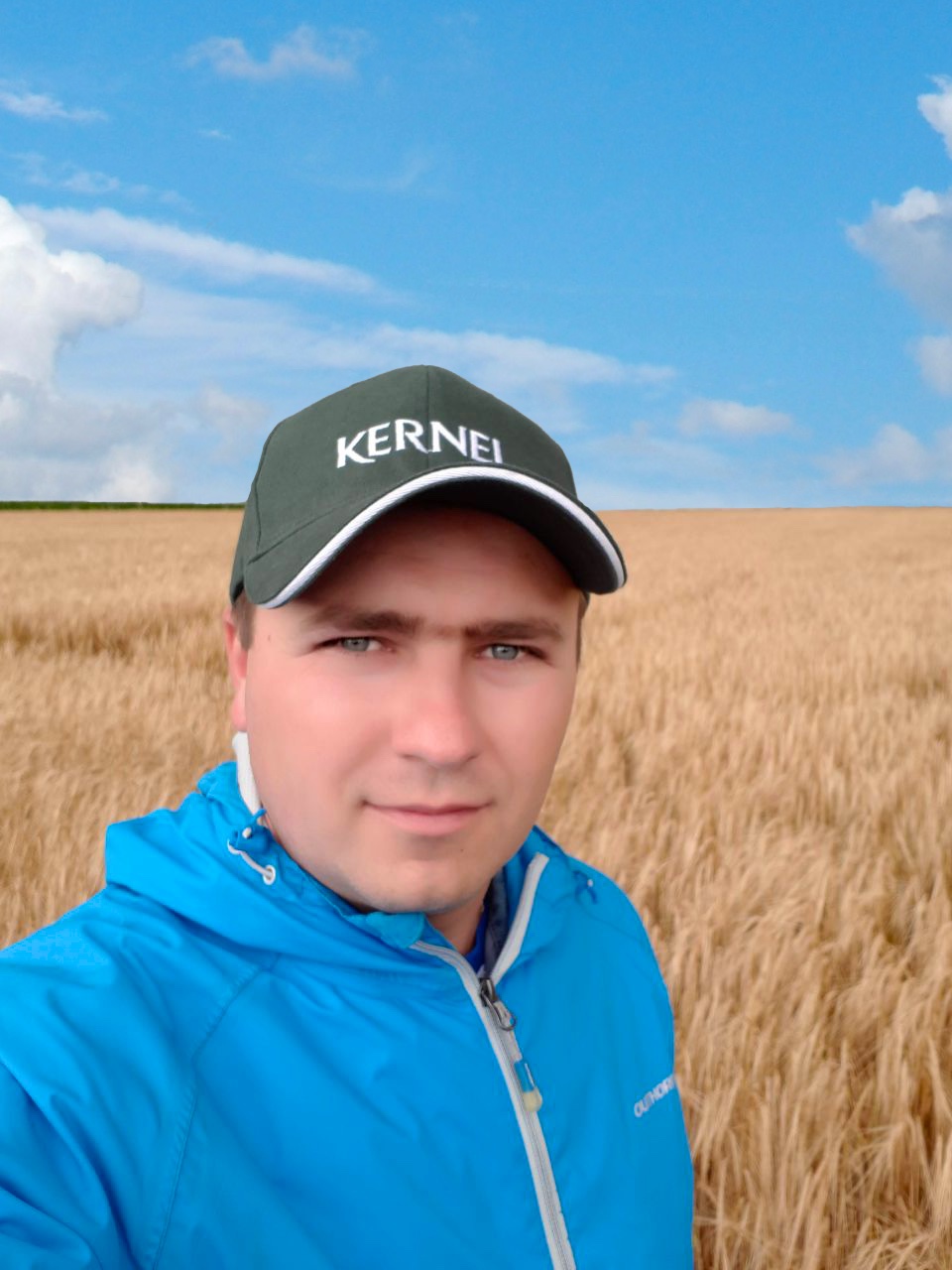
Valerii Datsenko, Head of Kernel’s Precision Agriculture Department
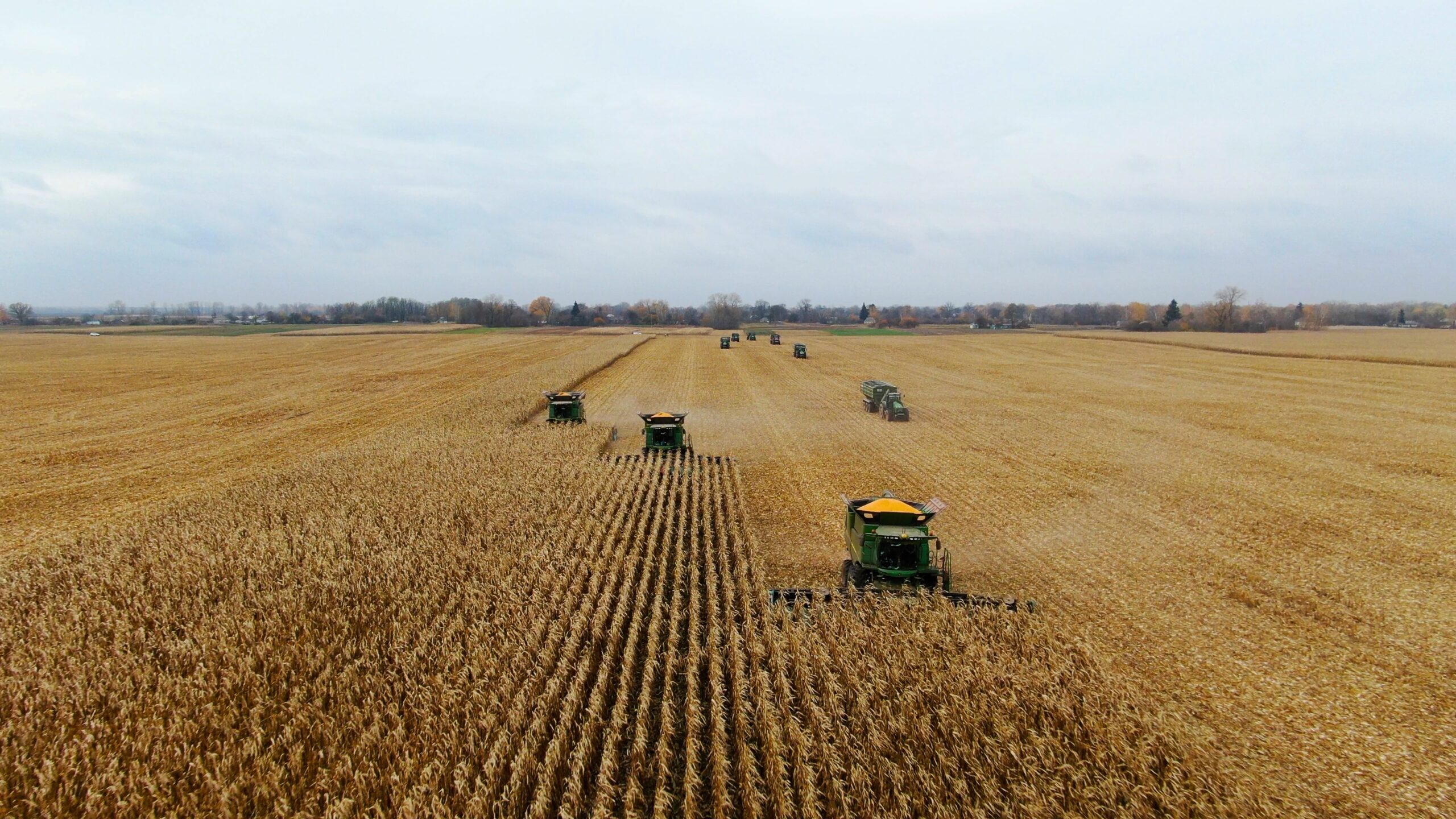
Kernel owns 90 combines and operates a fleet of several hundred combines with its partners.
How did the FarmTRX solution perform during the initial trials?
We did a small pilot project in 2020 with three first-generation models of the FarmTRX Yield Monitor. We were happy with the reliability, data sync to the portal, data quality, and the ability to produce good results despite data loss, etc.
The following year, we decided to evaluate Yield Monitor performance on a larger scale and installed about 50 Gen 2 devices on our own combines. Ease-of-installation and setup time was a priority during this test. Overall, the devices performed well.
Can you tell us about the development of custom features for Kernel?
We are constantly looking to improve our operations. During these first trials, we submitted a feature request to the FarmTRX team for a more precise GPS module. We needed better GPS data to enable more precise operations during air raid alerts, provide more accurate passes, and ultimately generate higher quality maps. I’m happy to say that the GPS capabilities on the Gen 3 and Gen 4 models – Yield Monitor Plus+ and Yield Monitor Pro – meet our needs.
Another feature we asked for was the ability to automatically sync yield data bidirectionally via API. FarmTRX responded by developing a custom API that allowed us to integrate the raw Yield Monitor data into our Farm Management System for further processing and analysis.
Moving on to operational details. Can you briefly describe your combine fleet?
Our own fleet consists of 90 combines, the bulk of which are:
- 2012 models of Case IH 5088, JD 9770, and Claas Tucano 470.
- 2016-2021 models of JD i670/680/690/770s
Our John Deere models are the only ones with factory-installed yield monitoring systems.
Some of our newer ones have been retrofitted with Active Yield, and some equipped with Precision Planting (JD9770). In addition to the fleet we own, we rent about 300 units/year of various combines.
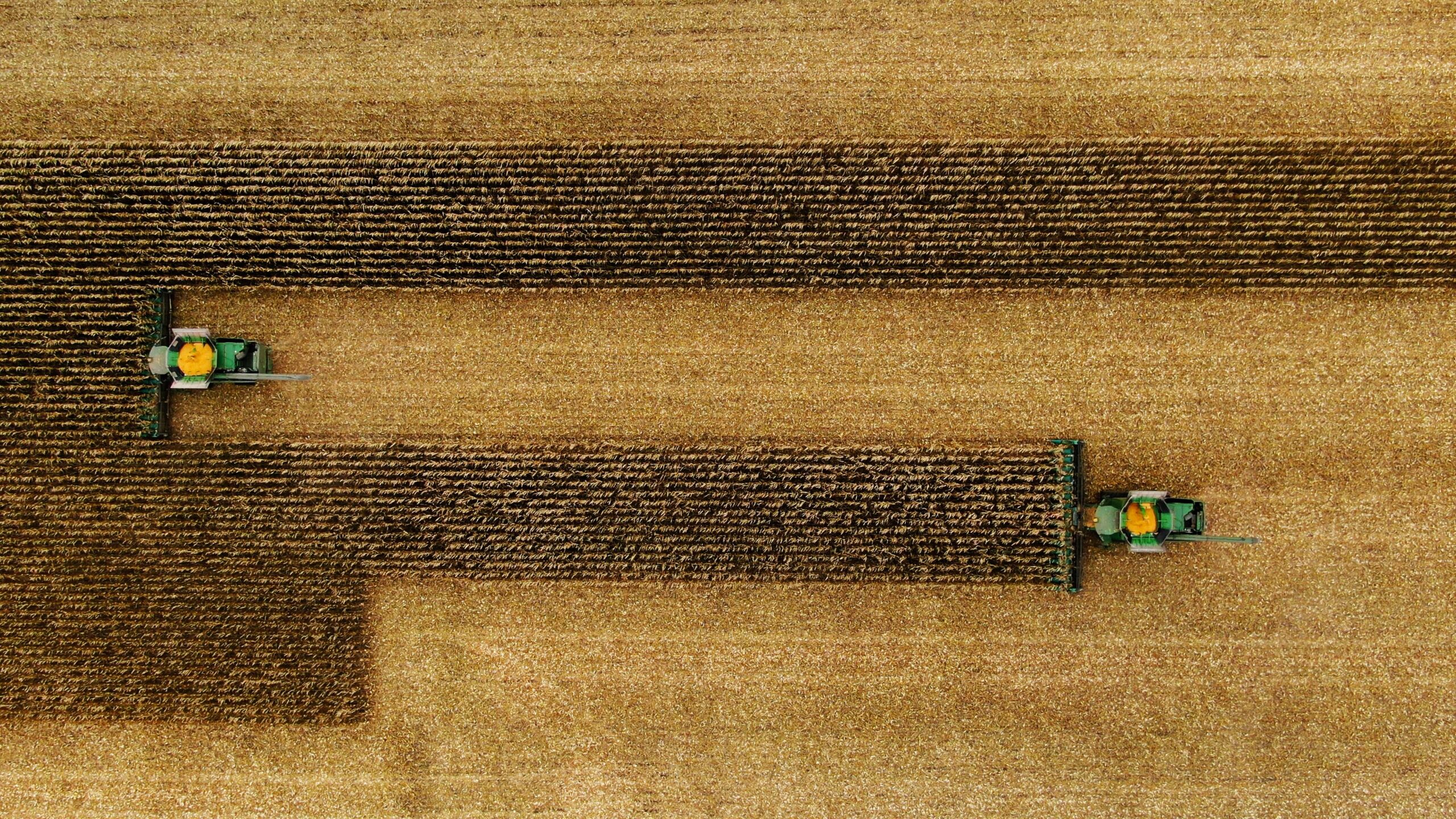
With its 6,000 fields and 500,000+ hectares of land, Kernel operates one of the largest grain farms in the world.
Let’s talk about the harvesting process. How many fields/hectares are you operating?
Kernel has around 6,000 fields and 500,000 hectares, or 1.2 million acres, used between us and our partners.
When does the harvest season begin and end for your growers?
Winter crop harvest begins in July and ends mostly in November. In rainy years, it ends in December.
Who owns/operates the combines?
The combines are proportionally distributed across Kernel’s different clusters and enterprises, where each division plays a specific role in the operation and maintenance of the fleet.
- Production – operations and configurations
- Agronomic – in-field operations
- Engineering – repairs and operation
- Dispatch-Logistics – movement logistics, crop removal from the field, and fueling
- Cluster specialists (teams from Engineering, Precision farming, and Agronomic service) – repair and maintenance
What information is available to the operators in the cab?
Operators can view basic parameters, i.e., the settings of the combine and header, as well as yield and moisture indicators.
Do you use autosteer capabilities?
Yes, some of our own combines, mostly JD models, have a high-quality autopilot and coverage synchronization, i.e. section control and headland management. These more advanced features are available only on combines with headers that are more than 9m wide.
What are the most common challenges during harvest?
The main challenge is working with generally outdated combines, including rented ones. Processing 1,500-3,000 hectares per year leads to fatigue of combine units and assemblies, so there’s a constant need for repairs. The availability and quality of spare parts can also be an issue.
Harvest time is busy, and the constant synchronization and calibration of yield data and yield losses puts pressure on everybody to keep up.
Finally, in an ideal world we’d like to be able to control the FarmTRX Yield Monitors remotely and use cameras to automatically detect crop and field conditions and configure the combine accordingly.
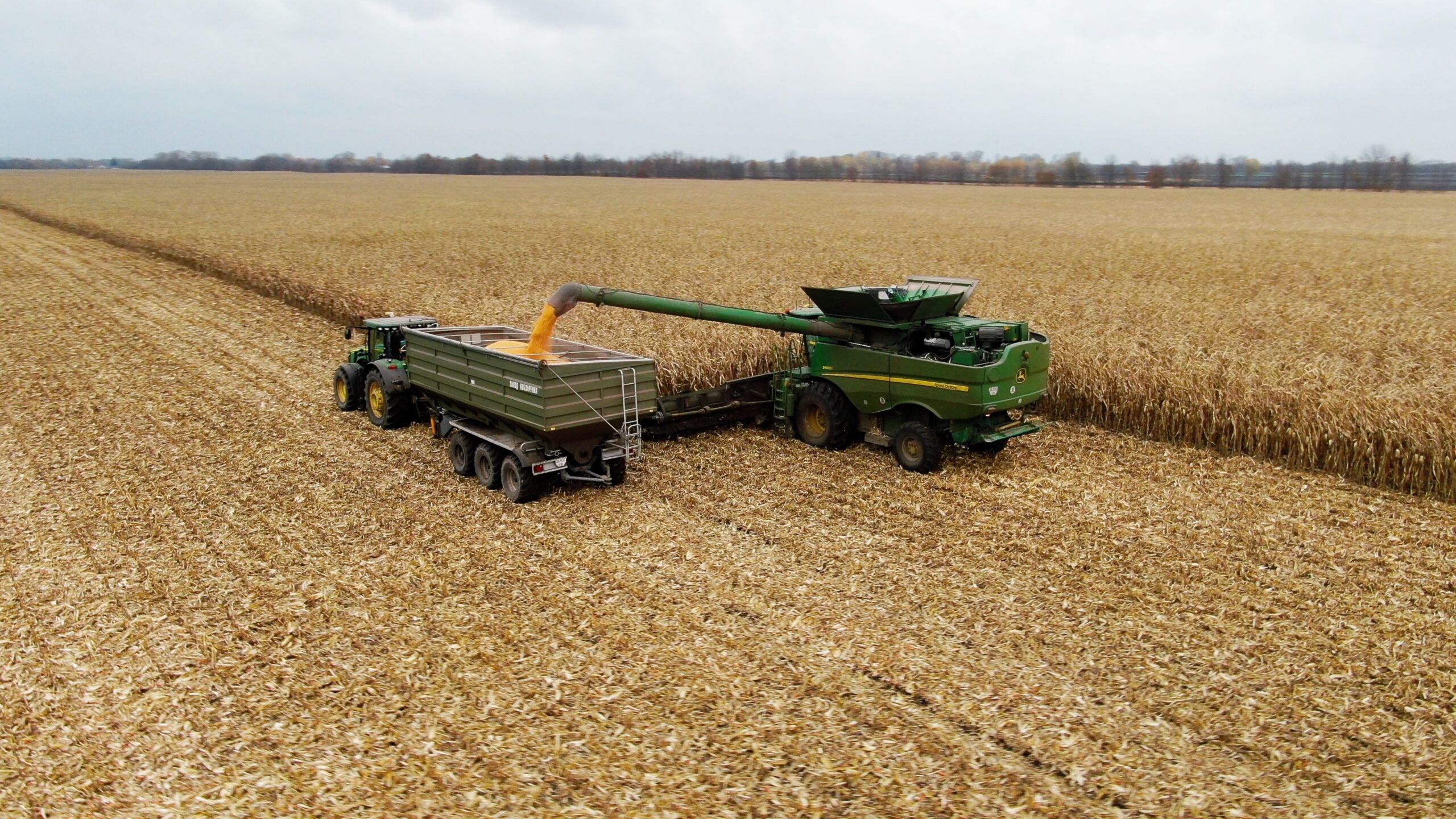
Kernel relies on yield maps to evaluate all their field experiments. Yield Monitors from FarmTRX deliver about 85% of Kernel’s yield data using a custom API that enables automatic bi-directional sync between yield monitor and DAB, Kernel’s in-house Farm Management System.
We’ll consider that another feature request 🙂 In the meantime, can you describe your farm management system and how FarmTRX yield data is integrated and used within it?
We have an in-house digital platform called Digital Agro Business, DAB, that we use to control all aspects of our production environment. DAB is divided into multiple modules:
- Planning – Variable rates, budgets, crop rotation etc.
- Scouting – Collecting mobile, satellite, and drone video data
- Data analysis – Collecting satellite data, weather, actual machinery data
- Wialon – Enterprise-grade fleet management solution for operational planning and control of technical operations
- GIS platform mapping service – We use ArcGIS and other web-based mapping services to build RX maps and reference directories of field boundaries and AB lines for autosteering. This module also includes additional data processing tools
- LIMS (Lab Information Management Software) – Our agrochemical laboratory platform
- Field Passport – Our proprietary application where all data is collected, processed, and analyzed
Do you generate yield maps for your fields?
Yes, we collect raw yield data from all FarmTRX Yield Monitors via a custom API. This data is used by the Field Passport application to generate clean and corrected yield maps. The yield data reflects the many variations in our fields, and a numerical yield value is given to each location.
Where does FarmTRX add the most value in your operation?
Our field experiments are qualitatively impossible without a yield map. I would say that yield maps provide the most value when we review the results of our experiments.
Yield maps also enable differential planting and variable-rate fertilizer applications, as they confirm High and Low productivity zones in the field, illustrated by the precise numerical values I mentioned.
How would you describe Kernel’s partnership with FarmTRX?
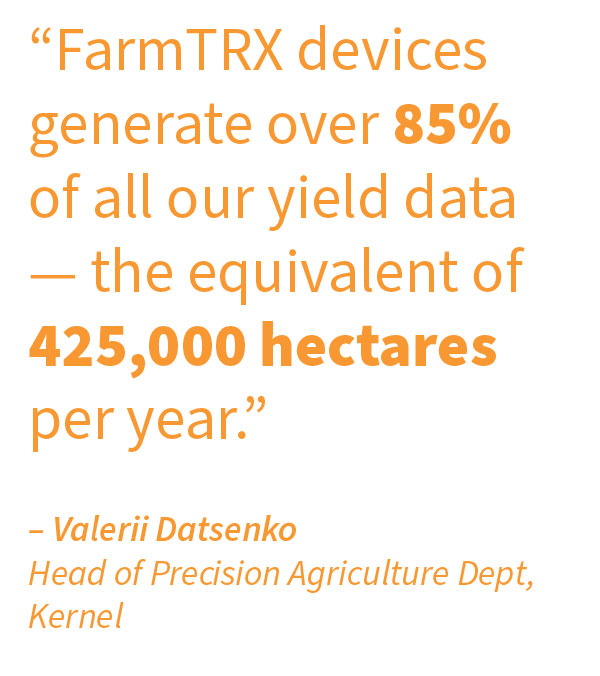
Overall, it has been very successful. After two years of scaling up and improving our precision agriculture operations, we now have quality yield maps for 99% of our fields. In my estimate, FarmTRX devices generate over 85% of all our yield data – the equivalent of 425,000 hectares per year.
Without this partnership, it would have taken us 3–5 more years to be where we are today. We are honored to collaborate with FarmTRX and pleased with the many developments that have been tailored specifically to our requests.
As a partner, FarmTRX has been very reliable. All large-scale orders have been delivered on time, we see continuous software improvements, and we have an ideal product today.
What’s next?
We look forward to our continued collaboration with FarmTRX to deliver even better precision agriculture solutions in the coming years.
As for future upgrades, we would like to see a hardware platform that remains compatible across generations. We would also love to have an ability to measure and manage grain losses behind the combine through universal loss sensors, automatic diagnostics of the elevator condition after installation, and perhaps automatic calibration of the mapping system.
I’ll definitely mention that to our team. Thank you for sitting down with us.
Thank you.